b2cBridge
Overview
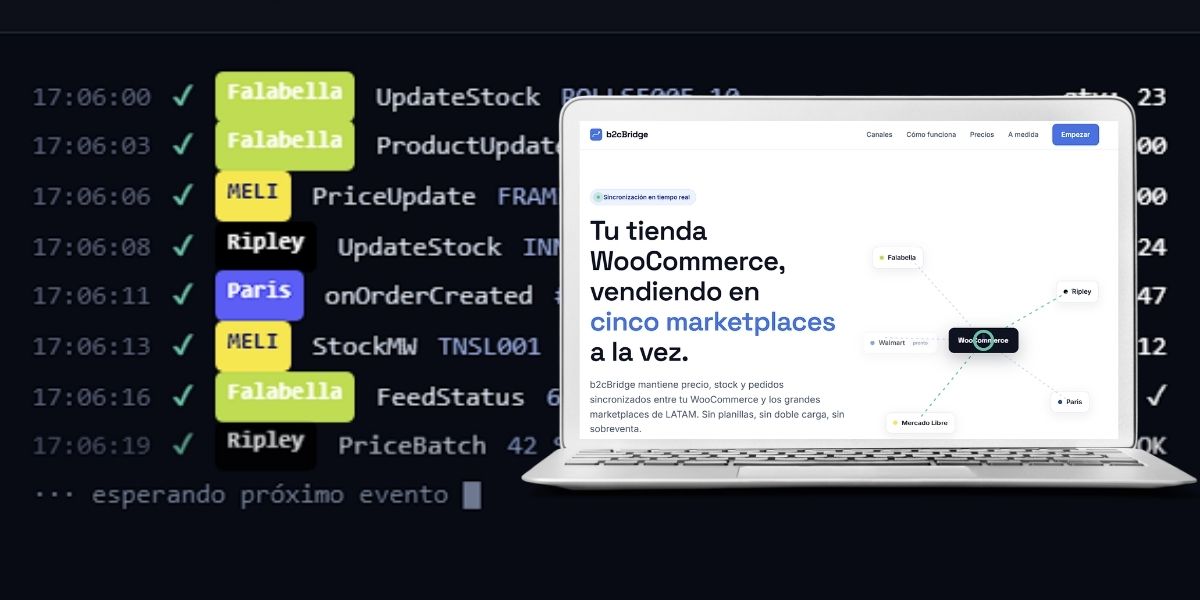
The challenge with b2cBridge didn’t come from a single customer—it came from seeing the same issue repeat itself with many of them. A brand sets up its store on WooCommerce, does well, and then opens a channel on Falabella. Then on Ripley. Then on Paris and Mercado Libre. From there, every price change has to be made five times, every inventory adjustment has to be made five times, and orders come in through five different dashboards that have to be checked one by one. The spreadsheet created to organize everything ends up being the weakest link in the operation: one slip-up is enough to sell something that’s no longer in stock, and overselling on a marketplace isn’t just paid for with a return—it’s paid for with the seller’s reputation. The tools that solved this problem came with an inconvenient catch. Almost all of them are cloud services: your catalog, your orders, and your customers are hosted on a third-party server; you’re charged per transaction or by sales volume; and your relationship with your buyer is mediated by a company other than your own. We felt that was the wrong approach. The goal was to build the opposite: for the integration to live **within** the customer’s store, for the data to never leave that space, and for the price to depend on how many channels you use—not on how much revenue you generate. The result is b2cBridge: a WooCommerce plugin that turns your own store into the hub of your entire multichannel sales operation. The promise fits in a single line—*your WooCommerce store, selling on five marketplaces at once, no spreadsheets, no double entry, no overselling*—and the architecture backs it up: products are managed just once, in WooCommerce, and that’s the single source of truth. Pricing, inventory, and orders are synchronized in real time with Falabella (Chile, Colombia, and Peru), Ripley, Paris by Cencosud, and Mercado Libre, with multi-warehouse support; Walmart is on the way. Synchronization isn't a simple on/off switch: each channel is activated separately and has its own margin setting, because commissions aren't the same everywhere, and selling at the same price everywhere means giving up profitability in some markets and losing competitiveness in others. Before opening a channel, you can test it in safe mode without publishing anything. Orders are imported directly into WooCommerce along with customer information, addresses, and shipping costs, and can be reimported on demand by ID or date range if an order is lost on the marketplace’s end. The electronic invoice is issued automatically via Lioren or Bsale, and the connection to the ERP system completes the loop with accounting. Every transaction—prices, inventory, orders, feeds—is logged, because when a number doesn’t add up, the question isn’t “what happened” but “when,” and without a log, that question has no answer. An anti-blocking relay maintains stable connectivity with platforms that penalize repeated connections, and variants—sizes, colors, formats—are shipped as complete sets rather than as individual items. The business model follows the same concept: an annual subscription via PayPal, with the price determined by the number of channels subscribed to. You pay for what you use, and your data never leaves your home.